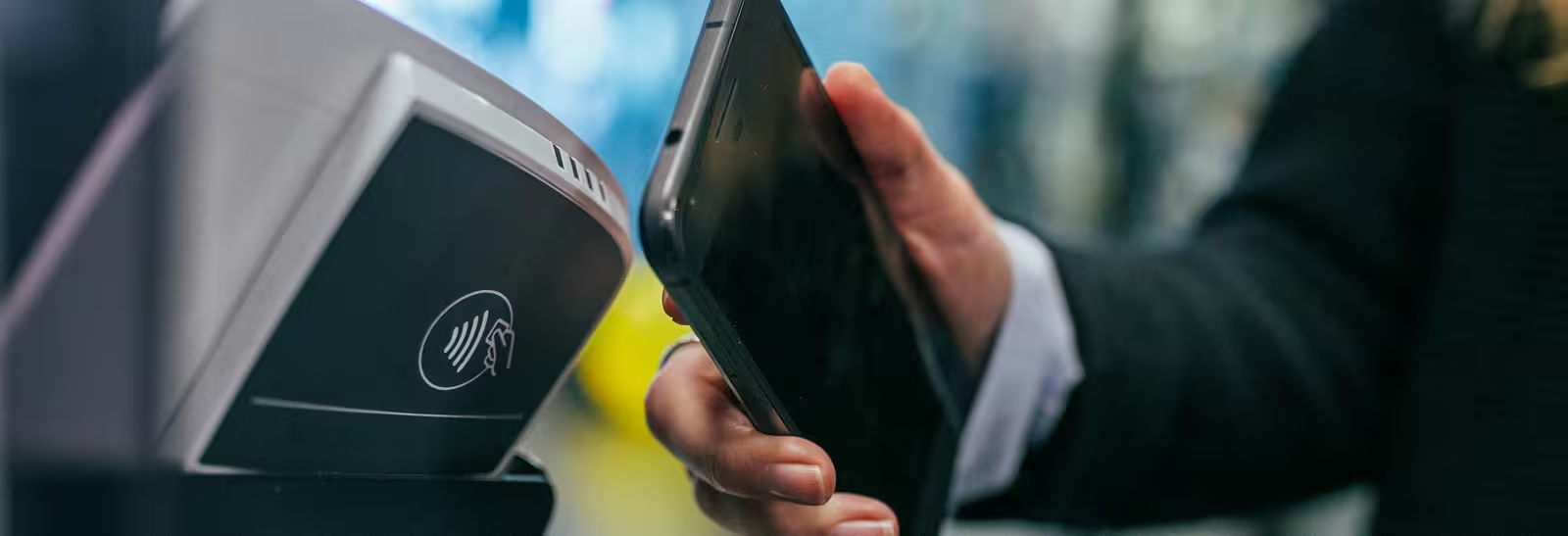
Anyone boarding a bus in London holds a bank card against a reader and sets off. Hardly anybody buys a ticket, and the system works out the right fare in the background. In Germany that convenience is still the exception, even though the underlying principle has been running here for years. In North Rhine-Westphalia and Baden-Württemberg, passengers have been checking in and out by app since well before the current debate. Now Berlin, Hamburg and Bavaria are following, and in Berlin and Hamburg the bank card itself is set to become the ticket.
For employers it is worth watching, because the people who stand to gain are exactly those who come into the office on single days and for whom a monthly season ticket rarely pays off.
The same principle sits behind every variant. Passengers register when they board and sign off when they get out, and the system in the background records the journey and bills it afterwards. Anyone travelling several times in a day never pays more than the price of a day ticket. Nobody has to know the fare zones.
The differences lie in the medium, and two approaches face each other here. With contactless payment, passengers hold their bank card against a reader in the vehicle or at the station, as in London, which is the model Hamburg and Berlin are working towards. The second variant runs through an app, where a swipe checks you in and out while the smartphone works out the route from location data. Baden-Württemberg and Munich follow this pattern.
Pricing differs as well. Some systems keep the classic fare, others bill by the straight-line distance between start and destination. What they share is retrospective billing at the best available price. The real difference is whether you need an account with a transport operator or only a card in your pocket.
The approach has been part of everyday travel longest in North Rhine-Westphalia. Under the name eezy.nrw the state runs a region-wide electronic fare in which passengers check in and out by app and the price is made up of a base rate plus the straight-line distance between start and destination. Fare zones, detours and the boundaries between transport associations no longer matter, and no more than 35.20 euros is charged within 24 hours, however many kilometres add up. Since the beginning of 2026, according to the operator, eezy.nrw has always been the cheapest option for single journeys in second class. This is also the model behind the debate about a nationwide Deutschlandticket light.
Baden-Württemberg is at a similar stage. In 2023 the state introduced a region-wide system together with all of its transport associations, and the Karlsruhe transport association recently added it to its own app. It is valid across local and regional transport throughout the state and beyond, for instance in the Rhine-Neckar association. The system recognises transfers by itself, a forgotten check-out is completed automatically, and a stored BahnCard is factored into the price. Bavaria follows from 2027 and plans to introduce its in/out system step by step, eventually across association boundaries. In Munich the solution already runs under the name Swiping.
In Berlin the changeover begins in 2029, and it is a good deal larger. The BVG is replacing its machines with around 3,600 validators, compact units with a display against which passengers hold a bank card, a smartphone or a prepaid card and choose from a reduced range of tickets. The ticket then sits in the cloud and is retrieved through the same card during an inspection. The reason for the change is tangible, because the technology in the 500 machines on the trams dates from before reunification and is 36 years old, that of the yellow boxes in the underground stations a mere 25. On top of that comes the requirement that all installations be accessible from 2030. That the sums add up is clear from a price comparison: a validator costs around 1,500 euros, a large yellow machine up to 40,000.
Hamburg takes its cue from London and wants to make the credit card a ticket by 2030. Passengers are to hold their card against a terminal in the ticket hall or on the bus without buying anything first. Behind this sits a growth target, because Hochbahn wants to lift passenger numbers by 30 per cent by 2035 and is aiming above all at people who currently board only occasionally.
Not everyone is joining in. Deutsche Bahn considers the approach unsuitable for long distances, and Nordbahn in Schleswig-Holstein wants to see results from other regions before committing.
Several reasons for starting the overhaul now happen to coincide. The old machines are at the end of their life cycle, and a validator costs a fraction of one. The accessibility requirements from 2030 force the replacement anyway. And payment behaviour has long since shifted, because 76 per cent of the BVG's machine revenue came from cashless payments in 2025, while more than half of its customers buy single tickets in the app in any case.
There is a strategic point as well. The Deutschlandticket radically simplified the fare landscape for frequent travellers. For everyone else it stayed complicated. Check-in/check-out systems are meant to close exactly that gap. Baden-Württemberg's transport minister Winfried Hermann puts it like this: not everyone wants or needs a Deutschlandticket, but people who travel rarely still need a simple ticket.
Almost every company has employees for whom a monthly season ticket does not pay off. Part-time staff are among them, people with two or three office days a week, and employees at sites with thin public transport. Today they either pay for a season ticket they barely use, or they buy single tickets and submit every receipt separately.
Check-in/check-out changes nothing about the expense process for now, but it does lower the hurdle in front of it. Anyone travelling by bus or train on the spur of the moment will need neither fare knowledge nor a season ticket. Once the systems run across the board, public transport becomes a realistic option for occasional travellers too.
Nobody has to wait for that. Both groups can already be supported in different ways today: frequent commuters with the Deutschlandticket as a job ticket, everyone else through a mobility budget that pays for single journeys, sharing services or the bike. With a mobility card, employees pay straight out of their budget without submitting receipts. If check-in/check-out systems take hold, journeys billed that way can be paid for by the same route.
A number of questions remain before the systems run everywhere. Passengers without a bank card need an alternative, which is why the BVG is planning prepaid cards at more than 900 outlets and keeping paper tickets. Contactless payment by card also requires every person to have their own means of payment, and group tickets on a single card are not provided for. The app variant solves this more elegantly, because in Baden-Württemberg up to ten people can be stored, one of whom can be taken along per journey.
And finally the timeline. Bavaria starts in 2027, Berlin in 2029, Hamburg by 2030. Anyone planning today should keep an eye on the subject without making their mobility strategy depend on it.