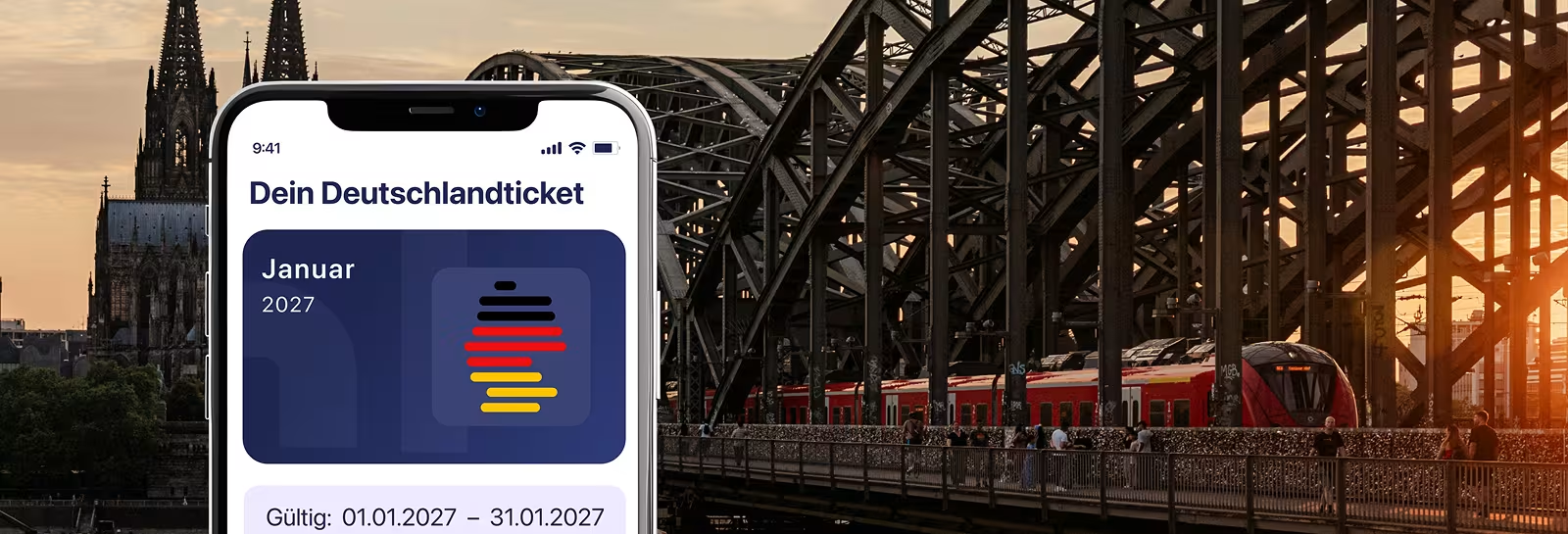
On 1 January 2027, the Deutschlandticket will become more expensive again. For the first time, the ticket price will be calculated automatically, and the price increase will be based on a price index adopted by the Conference of Transport Ministers (VMK) in March 2026.
For companies that offer a job ticket, this is more than a side note. The issue price determines the employer subsidy and therefore a recurring item in the HR budget. Find out here how the formula works, which prices are being discussed for 2027, and what this means for your own budget planning.
The price of the Deutschlandticket will keep rising. When the Deutschlandticket was launched in May 2023, it cost €49 a month. Less than two years later, it was €58, and since January 2026, its more than 14 million users have been paying €63. That is an increase of almost 30% in just under three years. The main reasons for the price increases are rising energy and staff costs. Next year, the Deutschlandticket is set to become more expensive again. Exactly how much more will be determined by a new way of calculating the price that seems complicated at first glance.
There is no official figure yet. The Conference of Transport Ministers will announce the binding price by 30 September 2026 at the latest. Three independently produced calculations nevertheless arrive at similar forecasts. Tagesspiegel and Deutsche Umwelthilfe (DUH, Environmental Action Germany) expect €66.40, while the data team of public broadcaster WDR arrives at €66.80 because of diesel price trends. The increase would therefore be between 5.4% and 6.0% compared with the current ticket price. For comparison: the jump from €49 to €58 was 18.4%, and from €58 to €63 it was 8.6%. The 2027 increase would therefore be the smallest since the ticket was launched.
The formula has two parts: the cost index and the value factor. From 2028, a third component will be added, the dampening factor. However, it plays no role in calculating the 2027 price.
The cost index
The cost index reflects how much more expensive it becomes to run buses, trams, and regional trains. Three blocks are included with different weightings:
The weighting of diesel stands out. It makes up almost 13% of the entire index, almost twice as much as electricity.
The value factor
The second part is a coefficient that reflects the ratio between government funding and ticket revenue. To calculate it, the compensation payments from the federal and state governments, around €3 billion a year in total, are divided by the revenue from all tickets sold.
These payments are capped until 2030, meaning they do not grow with costs. The value factor ensures that the difference is covered by the ticket price. It therefore amplifies the pure cost increase.
The main driver of the price increase is the price of diesel. According to Deutsche Umwelthilfe, the diesel price index recently rose by almost 10%, while the electricity price index rose by only 5%.
This has such a strong impact because local public transport is still largely fossil-fuelled. At the end of 2025, according to figures from the Federal Ministry of Transport cited by the Allianz pro Schiene rail association, only 63% of the federal rail network was electrified. On top of this come the bus fleets of local transport companies, which also run mostly on diesel.
Added to this are higher staff costs and the cap on federal and state subsidies of €1.5 billion each, mentioned above.
Not necessarily, but it won't get cheaper either. The decision contains a rule that is usually overlooked in media coverage. If the price index is positive, the ticket price rises. If it is negative, the price stays the same. The calculated saving does not lapse, however. It is carried over to the following year and offset there.
In practice, this means that falling costs reach users at most as a smaller next increase, and a price reduction is not part of the mechanism. The price therefore has only two states: unchanged or rising.
For companies, the regular ticket price is only the starting point. What matters is the interplay between the employer subsidy and the job ticket discount granted by the transport associations.
For the Deutschlandticket Job, the following applies: if the employer covers at least 25%, transport companies grant an additional 5% discount. The subsidy remains tax-free under Section 3 No. 15 of the German Income Tax Act (EStG). Here is a sample calculation based on the forecast price of €66.40:
The employer subsidy therefore rises by 85 cents per person per month, or €10.20 a year. With 1,000 participating employees, that is around €10,200 more, and with 5,000 participants around €51,000, in each case assuming the additional costs are not passed on to employees.
The Deutschlandsemesterticket for students is also linked to the base price, at 60% of it.
For companies, it is advisable to plan with a price range for now. The current forecasts range from €66.40 to €66.80. If you plan with the higher figure, you won't have to make adjustments in January. Employers should also make a note of 30 September. The Conference of Transport Ministers intends to announce the 2027 ticket price by then. In future, this date will also be the deadline for the following year's price every year, which is early enough for most budgeting processes.
At the same time, it is worth checking the amount of your subsidy. If you pay a fixed euro amount instead of a percentage, you should recalculate. As the base price rises, an unchanged amount can slip below the 25% threshold and cost you the 5% discount.
Last but not least, employers should inform their workforce in good time. With the last price increase, Deutsche Bahn subscribers had to actively agree to the new price level, otherwise their subscription ended at the end of the year. Whether this will happen again is still open. A reminder in the autumn helps prevent accidental cancellations.
Deutsche Umwelthilfe considers the price spiral counterproductive and warns of a dangerous downward spiral of rising prices, falling subscription numbers, and, as a result, growing pressure for the next increase. Instead, the organisation is calling for a nationwide €29 ticket for 12 months, followed by a stable price of €49.
Criticism from a different angle comes from the passenger association Pro Bahn in North Rhine-Westphalia. It would have preferred a higher launch price from the outset to keep the gap to the subscriptions of the regional transport associations smaller. There, the large price jumps are seen as a risk to the funding of local public transport.
The increases so far, however, have not led to a dramatic loss of subscribers. For many commuters, the Deutschlandticket remains the cheapest option even at €66, compared with the monthly passes of the respective transport associations.
From 2027, the price of the Deutschlandticket will follow a formula instead of a political agreement. Above all, this gives companies predictability and a traceable calculation. The expected increase is moderate. Around 85 cents more in employer subsidy per person per month can be absorbed by most budgets or, if necessary, passed on to employees.
More important than the individual amount is the mechanism behind it. As long as the government subsidy remains capped, the value factor amplifies every cost increase in local public transport, and falling costs never reach users as a price reduction. From 2028, the dampening factor rewards higher sales figures with smaller price increases, and the federal states explicitly name the Deutschlandticket Job as a lever for this. Companies that offer a job ticket therefore reduce price pressure for all users in the long term.
This article is for general information only and does not constitute tax or legal advice. The rules and calculations presented reflect the situation as of September 2026.