Anyone working in Munich can choose between 14 different sharing providers. In Leipzig, there are five. This is shown by an analysis by IFA Berlin, which compared the range of car sharing, bike sharing, e-scooters, and e-mopeds in Germany's 20 largest cities. The analysis counted the number of providers, not the number of vehicles. For companies with several locations, it is still a useful indicator: how well a mobility offering works for employees depends heavily on what is available locally.
Munich tops the analysis with 14 sharing providers, followed by Hamburg with 13. Berlin, Cologne, and Bonn each have 12 providers, and Dortmund and Stuttgart 11. At the other end is Leipzig with five; Mannheim, Bremen, and Bielefeld have six, and Nuremberg, Wuppertal, and Dresden seven.
However, the number of providers only says something about choice, not about availability. A single large provider with a dense network can do more for a city than five small ones with limited service areas.
According to the analysis, car sharing is the category with the most providers: 19 companies operate in the 20 cities. Only Flinkster, Deutsche Bahn's service, is available across the board in all 20 cities. Miles and cambio follow with nine cities each, and Free2Move and stadtmobil with seven each. Munich, Berlin, and Hamburg have the greatest choice, with six car sharing providers each.
The number of vehicles is even more telling. At the start of 2026, the German Car Sharing Association (Bundesverband Carsharing) counted 43,190 car sharing vehicles nationwide, just over a fifth of them electric. In the association's city ranking, which compares vehicles per 1,000 residents, Karlsruhe is well ahead of Munich and Hamburg. The city doesn't appear in the IFA analysis at all, because it is not one of the 20 largest cities.
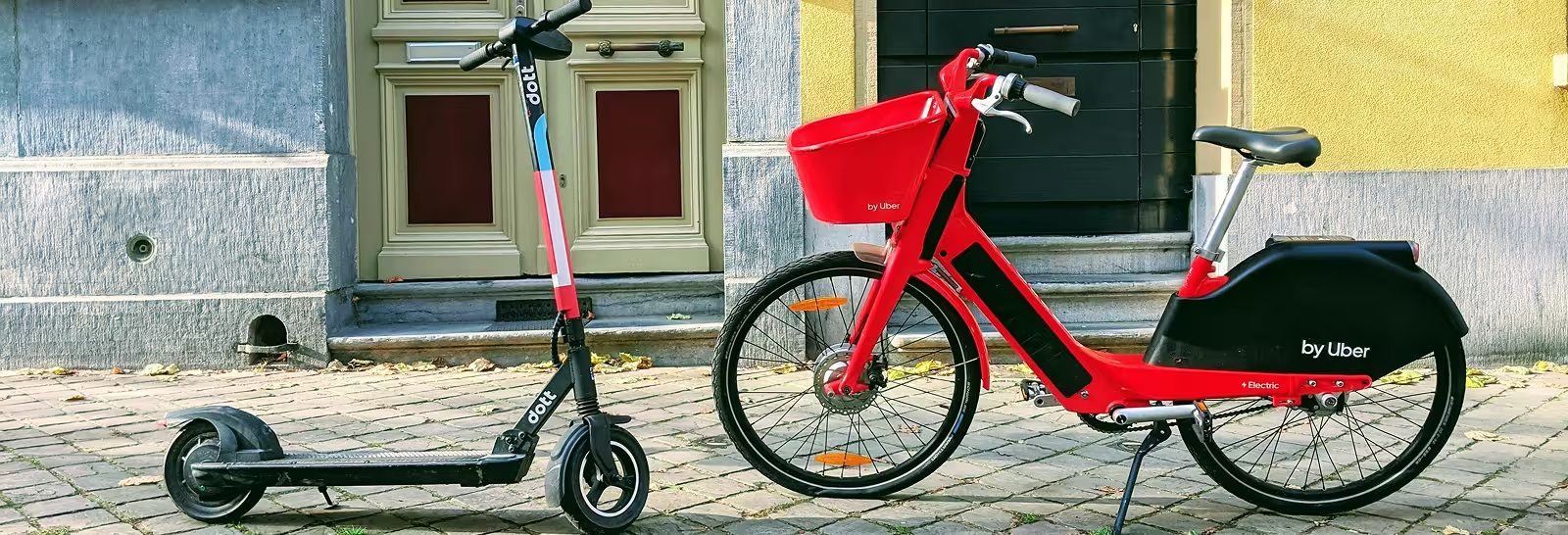
Eight providers operate in bike sharing. The most widespread is nextbike, with services in 12 cities, often under a local name. It is followed by Lime with eight cities and Call a Bike with six. Munich and Berlin have the greatest choice with five providers each, while 12 of the 20 cities have only a single bike sharing system.
E-scooters, on the other hand, are available almost everywhere, and from the same few companies: Voi operates in 18 of the 20 cities, Dott in 17, and Bolt and Lime in 16 each. E-moped sharing offers the least choice. emmy is only available in Berlin, Hamburg, and Munich, while local providers operate in Bonn and Stuttgart.
For companies with a location in Munich or Hamburg, shared mobility is a real alternative for business trips or for employees' commutes. At locations with few services, the picture is different. A mobility benefit that only covers certain providers falls flat there. A mobility budget that is not tied to any specific service and also covers the Deutschlandticket or company bike leasing is more flexible.
The IFA analysis provides a quick overview but not a complete assessment. It counts providers, not vehicles, service areas, or prices, and states neither a cut-off date nor a methodology. Taxis, ride pooling, and public transport are not included. Anyone planning a mobility budget for their company location should therefore check which providers actually reach the company premises and the places where employees live.
Sources: IFA Berlin, "Sharing-Analyse: Diese Städte bieten die größte Anbietervielfalt" (April 2026); Bundesverband Carsharing e.V., Carsharing-Statistik 2026 and Jahresbericht 2024/2025.